Advertisement
Cleaning 3m read
0

The Hack That Makes Deodorant Marks Disappear

Deodorant marks on clothing seem like they shouldn’t be a big deal. How bad can a few white marks really be? But anyone who has ever looked closely at the armpits of a black T-shirt knows it’s not that simple. Although they seem like something you could get rid of with a simple wash cycle, those deodorant marks actually require a bit of finesse to remove completely. That’s where this clever hack comes in.

All featured products and deals are selected independently and objectively by the author. House Outlook may receive a share of sales via affiliate links in content.

Deodorant marks on clothing seem like they shouldn’t be a big deal. How bad can a few white marks really be? But anyone who has ever looked closely at the armpits of a black T-shirt knows it’s not that simple. Although they seem like something you could get rid of with a simple wash cycle,…

Friction Is Your Friend

For deodorant marks that are recent or not yet deep-set, simply rub them with a sock, a pair of stockings, or another clean clothing item. The friction created by the fabric rubbing together helps lift the deodorant, as long as the mark is relatively fresh.

For deep-set deodorant stains, such as the ones that tend to haunt the armpits of well-loved T-shirts, a bit more elbow grease is required. (Don’t worry, it’s still easy.) Start by combining 1 to 2 teaspoons of liquid dish soap with 1/4 cup of water in a small bowl. Use a stain brush or an old toothbrush to work the solution into the stained area. This step helps to break down the oils in the deodorant. Next — and this part is key — apply a rust stain remover to the deodorant marks, making sure the stained area is fully saturated. Be sure to use a product that is formulated specifically for laundry.

Rust stain removers do the trick because many deodorants contain metals, specifically aluminum. These metals can rust, making them harder to remove from fabric. Before applying the product, conduct a spot test on a small, concealed area of the garment. After 15 minutes, check to see if the rust stain remover has caused any discoloration or damage to the fabric. You should also cross-reference the product label with the garment’s care label to make sure they’re compatible. If it’s safe to proceed, leave the rust stain remover on the stain for 15 minutes, then wash the item as usual.

Advertisement

Tips and Tricks

After washing, make sure you inspect your clothes before putting them in the dryer. The heat of the dryer further sets stains into fabric, so if your clothes don’t look deodorant-free, repeat the process before drying.

Related: 3 Hacks for Getting Rid of Grass Stains Fast

If you use an aluminum-free deodorant (and you’re sure it’s free of other metals), you can skip the rust stain remover step entirely. Just apply the liquid dish soap and water and launder as usual. For good measure, let the dish soap and water mixture sit for 15 minutes before the wash.

Advertisement
Advertisement
Decorating 3m read
0

Are You Hanging Your Curtains Too Low?

Never underestimate the power of a perfectly hung curtain. Curtains add drama, sophistication, texture, and even the illusion of extra height to a space — and that’s all on top of their practical jobs of providing privacy and diffusing sunlight. However, the placement of the curtains is what will truly make or break their aesthetic appeal.

All featured products and deals are selected independently and objectively by the author. House Outlook may receive a share of sales via affiliate links in content.

Never underestimate the power of a perfectly hung curtain. Curtains add drama, sophistication, texture, and even the illusion of extra height to a space — and that’s all on top of their practical jobs of providing privacy and diffusing sunlight. However, the placement of the curtains is what will truly make or break their aesthetic appeal.

Hung too low, curtains can cause your windows to feel squat. Hung high, they transform the entire space with a grand effect. When in doubt, remember these guidelines: Go higher, wider, and longer.

Raise the Rod

A common mistake is hanging a curtain rod directly above the window frame, says interior designer Vicki Zagrodnik of Madison, Wisconsin-based Sims. Instead, aim higher. “Hanging curtain rods closer to the ceiling will make the room taller and elegant,” she explains.

Related: This Curtain Hack Adds Instant Drama (and Height) to Any Room

Zagrodnik also recommends extending the rod beyond the window frame to further trick the eye. “Extending the curtain rod on both sides of the windows ensures that the curtain will not block the natural light coming in and will give an illusion of oversized windows,” she says. It may help to envision your curtains framing an entire wall, not just a single window.

Advertisement

Length and Width Are Important Too

Length matters just as much as height. A curtain that’s too short looks awkward and unfinished. “Let the curtains puddle slightly or have them graze the floor for a more relaxed vibe,” Zagrodnik says. “The length of the curtain reflects the overall design of the room. Short curtains may make the room look cheaper and smaller.”

Fullness is another often-overlooked detail that makes a big difference. A good rule of thumb is to choose curtains that are about twice the width of your window. This prevents them from looking skimpy when closed and creates a more graceful drape when open.

Bonus Tip: Double Up for Drama

For an especially polished look, Zagrodnik recommends layering a sheer panel with a heavier drape. “That [will] give you soft, filtered light during the day and privacy or darkness at night,” she says.

Advertisement
Featured Image Credit:  | Updated  Sep 29, 2025 |
Megan McCarty
Writer
Megan McCarty is a Los Angeles-based writer who covers the fun stuff: design, travel, wellness, beauty, and fashion. She has written for publications including Domino, The Spruce, MyDomaine, Bustle, and Rue Magazine. Her life rules include, but are not limited to, zipper when merging, contribute to your IRA, and do the nice thing.
This article is for general informational purposes only.
Featured Image Credit:  | Updated  Sep 29, 2025 |
Advertisement
Home Improvement 3m read
0

Out of AA Batteries? Try This Quick Fix

Imagine you’re lounging on the couch flipping channels when the remote suddenly goes dead. The simplest solution would be to grab some fresh AA batteries, but there’s one problem: The box of AAs is completely empty.

All featured products and deals are selected independently and objectively by the author. House Outlook may receive a share of sales via affiliate links in content.

Imagine you’re lounging on the couch flipping channels when the remote suddenly goes dead. The simplest solution would be to grab some fresh AA batteries, but there’s one problem: The box of AAs is completely empty.

While you could go to the store and buy new ones, putting on pants and driving several miles may seem like too much effort in the moment, especially if you planned to spend the evening relaxing. Instead, here’s a quick replacement for those dead AA batteries that works perfectly when you’re in a pinch.

AAA Is A-OK

If you’re out of AA batteries but have plenty of AAAs lying around, you’re in luck. Despite their smaller size, AAAs have the same voltage as AAs, meaning they can temporarily power a device that normally requires the larger size. The only issue is getting the AAA battery to fit snugly, as it’s too small on its own. Fortunately, you can easily MacGyver together a solution, and all you’ll need is a bit of aluminum foil.

Warning

Only attempt this hack on low-power devices, such as remotes or clocks. Follow the directions closely; if you accidentally position the foil to connect the positive and negative ends, you risk creating a short circuit that could cause the device to overheat or even start a fire.

Advertisement

Since aluminum conducts electricity, it can be wedged between the battery and the negative terminal (the metal contact point, often a spring, at the battery slot’s negative side) to supply power to the device. Take a little bit of foil, roll it into a ball, and then press it into the gap between the flat, negative end of the AAA battery and the terminal slot. Finally, put the cover back on, and the electrical current should start flowing once more.

A Short-Term Solution

Just keep in mind that this is not a permanent fix — the smaller AAA batteries will drain faster than their AA counterparts. However, this trick will solve your problem for a couple of hours, allowing you to keep watching TV on the couch for now and worry about going to the store for new batteries tomorrow.

This hack is also useful if you find yourself far from any available batteries, such as when you’re camping. If the AAs in your flashlight die, just take a AAA battery out of a less crucial device, grab some aluminum foil from the campsite, and get your flashlight working again.

Advertisement
Featured Image Credit:  brizmaker/ iStock | Updated  Sep 29, 2025 |
Bennett Kleinman
Staff Writer
Bennett Kleinman is a New York City-based staff writer for Inbox Studio, covering topics for several brands including House Outlook and Better Report. He previously contributed to television programs such as "Late Show With David Letterman" and "Impractical Jokers," and digital publications like The Onion. Bennett is also a devoted New York Yankees and New Jersey Devils fan, and thinks plain seltzer is the best drink ever invented.
This article is for general informational purposes only.
Featured Image Credit:  brizmaker/ iStock | Updated  Sep 29, 2025 |
Advertisement
Gardening 3m read
0

Frost Warning? Try These 3 Hacks To Save Your Plants

Unless you live deep in the Sunbelt, the length of your gardening season is entirely dictated by the dates of your first and last frost. These dates tell you when to plant, when to harvest, and to some extent, what you can and can’t grow. However, dedicated gardeners have evolved plenty of clever hacks to help prevent frost damage and keep their cold-sensitive plants going for a few precious extra weeks. When that first frost warning inevitably comes along, here are three of our favorite frost protection tips.

All featured products and deals are selected independently and objectively by the author. House Outlook may receive a share of sales via affiliate links in content.

Unless you live deep in the Sunbelt, the length of your gardening season is entirely dictated by the dates of your first and last frost. These dates tell you when to plant, when to harvest, and to some extent, what you can and can’t grow. However, dedicated gardeners have evolved plenty of clever hacks to…

1. Covering Plants With Cloches

A cloche is simply a self-contained cover for a plant. While you can find them sold at garden centers and online, you can easily DIY your own. Depending on the size and shape of the plant, you can cut the bottom from a gallon milk jug or a half-gallon soda bottle to create a functional cloche. For larger plants, big water-cooler bottles can work, even though you’ll lose your deposit. Just remember to put these covers on in the evening, and then take them off the next day before the sun gets too high (lest your plants, ironically, overheat).

2. Preventing Frost Damage With “Found” Fabrics

For plants too large for a cloche, or when you need to protect entire garden beds, you’ll need much bigger covers. While plastic covers or tarps are popular — and they certainly do help — woven fabric offers better protection. Old bedsheets make great covers, especially when doubled, since they’re lightweight and easy to handle. Light blankets are even better, though their weight means you’ll need stakes to support them so they don’t break the plants. If there’s rain in the forecast, use your plastic covers or an old shower curtain liner as an outer layer over the fabric. Otherwise, the fabric will get heavy and damage the plants.

Advertisement

3. Watering Your Plants Well

This form of frost protection relies on basic physics. Frost causes damage by lowering the temperature around the plant’s roots and surfaces, and cold-sensitive plants have little ability to defend themselves. (Pro tip: Don’t waste your efforts protecting cold-tolerant vegetables such as kale, broccoli, and peas, or hardy ornamentals and perennials. They’ll be just fine.)

Related: The Secret to Mums That Last All Fall

Watering the soil heavily before a frost provides excellent protection because the water acts as a thermal sink. It takes a significant amount of chilling to lower the temperature of a liquid. Think of putting a soda in the fridge and impatiently waiting for it to get cold. Watering your plants works on that same principle: By the time the water has absorbed all that cold, the frosty part of the night will mostly be over. You can double down on this hack by combining it with the other two for maximum frost protection.

Advertisement
Featured Image Credit:  Graphithèque/ Adobe Stock | Updated  Sep 29, 2025 |
Fred Decker
Writer
Fred Decker is a trained chef and former restaurateur. Since closing his restaurants over a decade ago he has been a prolific freelance writer, publishing several thousand articles on dozens of high-volume websites including Taste Of Home, Hunker, Tasting Table, Week&, eHow, and GOBankingRates. He lives on a rural acreage shared with a big garden, chickens, rabbits, and grandkids.
This article is for general informational purposes only.
Featured Image Credit:  Graphithèque/ Adobe Stock | Updated  Sep 29, 2025 |
Advertisement
Food & Drink 4m read
0

Want Tender, Juicy Chicken? Try This Easy Trick

Chicken is one of the most popular protein sources, and for good reason: It’s flavorful, versatile, and generally affordable. Its only real flaw is that it’s relatively easy to overcook. Ideally, chicken should be tender and juicy, but when it’s overdone, it can become dry and tough. Fortunately, there’s a simple and easy trick, beloved by chefs and home cooks alike, that can help you get juicy, tender chicken every time: brining.

All featured products and deals are selected independently and objectively by the author. House Outlook may receive a share of sales via affiliate links in content.

Chicken is one of the most popular protein sources, and for good reason: It’s flavorful, versatile, and generally affordable. Its only real flaw is that it’s relatively easy to overcook. Ideally, chicken should be tender and juicy, but when it’s overdone, it can become dry and tough. Fortunately, there’s a simple and easy trick, beloved…

How To Brine a Chicken

So, how does it work? Through a process called osmosis. When you put your bird in salted water, the salt alters the protein structure of the meat, allowing it to absorb some of the brine. Then, as the chicken cooks, that trapped brine seasons the meat and keeps it moist, providing a safeguard against overcooking.

The steps are easy to follow. You’ll need a container that can hold your chicken and won’t react with the salt or any acidic ingredients you add. Consider using glass, stainless steel, food-grade plastic, or ceramic. For easier cleanup, you can also use a leakproof freezer bag.

Add the chicken to the container and enough water to fully submerge it. Then, remove the chicken, measure the water you’ve used, and add enough salt to get the right concentration. A good rule of thumb is 1 cup of salt per gallon of water, but this is only a rough estimate because salt crystal sizes vary greatly. Table salt is finer than pickling salt, which is finer than Morton’s, which is finer than Diamond Crystal. It’s often helpful to use an online “brining calculator,” which lets you specify the type of salt you’re using for better accuracy.

Advertisement

Regardless of the salt you choose, a whole chicken should brine for at least four hours and no more than 12 hours. For boneless, skinless chicken breasts, you only need about 30 minutes to two hours. While brining chicken thighs is not always necessary, if you choose to do so, one to two hours should be sufficient. For bone-in cuts, allow two to four hours for brining.

Tip: Check the label to see if your chicken has been preseasoned. Those are likely already brined, so you won’t want to do it again.

Dry Brine Your Chicken

That may sound like a lot of work, and it can be. You’ll also need to make sure you have enough fridge space for a container full of bird and brine. This is why many cooks prefer dry brining, which means you don’t have to contend with a large container of salty water. A dry brine is as simple as rubbing your chicken with salt and letting it sit.

Advertisement

The process still works because the salt draws moisture from the chicken, which dissolves the salt and creates a small amount of concentrated brine. That brine is then reabsorbed into the bird, seasoning the meat and altering its structure just enough to help it retain its own moisture better. Not only is it a simpler method, but it also gives you a more concentrated chicken flavor.

Related: Why You Should Always Add a Carrot to Your Frying Pan

You don’t need as much salt, either — just about ½ ounce by weight, rubbed evenly all over a whole chicken or individual cuts. Simply leave the chicken — whether it’s a whole bird or individual cuts such as thighs or breasts — uncovered on a plate in the fridge overnight, and you’re good to go. There’s no need to rinse the chicken before cooking, as this can spread bacteria around your kitchen and wash away the flavor. Patting the meat dry, however, will help you achieve delicious, crispy skin.

Advertisement
Featured Image Credit:  haha21/ iStock | Updated  Sep 29, 2025 |
Fred Decker
Writer
Fred Decker is a trained chef and former restaurateur. Since closing his restaurants over a decade ago he has been a prolific freelance writer, publishing several thousand articles on dozens of high-volume websites including Taste Of Home, Hunker, Tasting Table, Week&, eHow, and GOBankingRates. He lives on a rural acreage shared with a big garden, chickens, rabbits, and grandkids.
This article is for general informational purposes only.
Featured Image Credit:  haha21/ iStock | Updated  Sep 29, 2025 |
Advertisement
Decorating 3m read
0

How Long Is Too Long To Burn a Candle?

Candles are one of life’s greatest little luxuries. They instantly set the mood, making any space — whether it’s a living room, a bedroom, or a bathroom — feel cozy while smelling incredible. But while lighting a candle may seem effortless, for safety’s sake, there’s actually some science behind how long you should let that flame burn.

All featured products and deals are selected independently and objectively by the author. House Outlook may receive a share of sales via affiliate links in content.

Candles are one of life’s greatest little luxuries. They instantly set the mood, making any space — whether it’s a living room, a bedroom, or a bathroom — feel cozy while smelling incredible. But while lighting a candle may seem effortless, for safety’s sake, there’s actually some science behind how long you should let that…

Burn it too briefly, and you’ll waste wax; burn it for too long, and you could damage the candle or the surface it sits on. Follow these simple burn-time guidelines to get the most glow for your buck.

Why You Shouldn’t Burn a Candle for More Than Four Hours

While there’s no need to set a timer, you should be careful not to burn a candle for longer than four hours at a time. After that mark, the wick can develop a “mushroom” — a carbon buildup that causes popping, uneven flames, and extra smoke. That’s not a relaxing way to bask in candlelight.

Excessive burn times also create a safety hazard. While candle jars are designed to handle warmth, they’re not intended to handle hours of intense heat. If the glass overheats, it can crack or shatter, which could lead to hot wax and broken glass all over your furniture.

How Long To Burn a Candle for Even Wax

Candle connoisseurs know the first burn is the most important. Don’t light it 15 minutes before your bedtime — it’s imperative to give the wax enough time to melt evenly across the entire vessel. This prevents the dreaded “tunneling” effect, where wax clings stubbornly to the sides (though there are tricks to fixing a tunneled candle).

Advertisement

So, how long should you let a candle burn? Burning it for one to three hours at a time will maximize your candle’s lifespan while keeping your home safe.

Related: A Quick Fix for Leaning Taper Candles
Bonus Tip: Don’t Forget To Trim the Wick

A little wick trim goes a long way. For a cleaner, longer-lasting burn, snip the wick to about a quarter-inch before each lighting. This step helps prevent wick mushrooming, reduces smoke, and keeps the flame even.

Advertisement
Featured Image Credit:  Anna Shvets/ Pexels | Updated  Sep 29, 2025 |
Megan McCarty
Writer
Megan McCarty is a Los Angeles-based writer who covers the fun stuff: design, travel, wellness, beauty, and fashion. She has written for publications including Domino, The Spruce, MyDomaine, Bustle, and Rue Magazine. Her life rules include, but are not limited to, zipper when merging, contribute to your IRA, and do the nice thing.
This article is for general informational purposes only.
Featured Image Credit:  Anna Shvets/ Pexels | Updated  Sep 29, 2025 |
Advertisement
Cleaning 3m read
0

Pine-Sol in Laundry? Here’s Why It’s a Game-Changer

Tired of Tide? Done with Downy? Gaining nothing from Gain? If so, we may have the solution to your laundry woes. Believe it or not, Pine-Sol — yes, the multipurpose cleaner — is a surprisingly effective tool for eliminating strong, musty odors from clothing. Here’s why you should give this game-changing tactic a try.

All featured products and deals are selected independently and objectively by the author. House Outlook may receive a share of sales via affiliate links in content.

Tired of Tide? Done with Downy? Gaining nothing from Gain? If so, we may have the solution to your laundry woes. Believe it or not, Pine-Sol — yes, the multipurpose cleaner — is a surprisingly effective tool for eliminating strong, musty odors from clothing. Here’s why you should give this game-changing tactic a try.

More Than Just a Fresh Scent

Unlike other multisurface cleaners, Pine-Sol is perfectly safe to use in a laundry load, as long as you add it to a wash with only water and regular detergent. Be sure to never mix Pine-Sol with bleach or ammonia (or anything containing either of those ingredients), as that can produce toxic fumes. As long as you follow this one (very important!) rule, it’s completely fine, a fact confirmed on the brand’s own website.

Start by sorting your laundry into whites and colors. Then, add one of the piles of clothes to the machine along with your regular detergent — just make sure it’s bleach- and ammonia-free.

Related: This Genius Laundry Hack Can Significantly Reduce Drying Time

Before you start the wash, add ¼ cup of Pine-Sol Multisurface Cleaner to the main wash compartment — avoid adding it directly into the drum or the softener compartment. It’s safe to mix Pine-Sol with your detergent in the main wash compartment but be careful not to overfill it. Now, continue the wash and dry cycles as normal, and your laundry will come out fresher than ever. You might also notice that the inside of your washing machine looks cleaner after using this method.

Advertisement

This trick works particularly well for tackling those gross, musty odors that regular detergents may struggle to eliminate. It’s also capable of getting rid of tougher grease and oil stains, so consider trying it with your next load of odorous or heavily stained laundry.

Test Before You Wash

According to the parent company, “Pine-Sol Multisurface Cleaner is recommended for colorfast items only.” So, before you use it, you should always spot-test your clothing. Here’s how: Apply a single drop of Pine-Sol to a concealed, colorful area of the garment, wait five minutes, and then rinse it out with water. After the spot has dried, if the color remains unchanged, it’s safe to use. But if you notice any discoloration, it’s best to avoid using Pine-Sol with that piece of clothing.

Advertisement
Featured Image Credit:  SOPA Images Limited/ Alamy Stock Photo | Updated  Sep 29, 2025 |
Bennett Kleinman
Staff Writer
Bennett Kleinman is a New York City-based staff writer for Inbox Studio, covering topics for several brands including House Outlook and Better Report. He previously contributed to television programs such as "Late Show With David Letterman" and "Impractical Jokers," and digital publications like The Onion. Bennett is also a devoted New York Yankees and New Jersey Devils fan, and thinks plain seltzer is the best drink ever invented.
This article is for general informational purposes only.
Featured Image Credit:  SOPA Images Limited/ Alamy Stock Photo | Updated  Sep 29, 2025 |
Advertisement
Organizing 3m read
0

Why Every Home Needs an ‘I Don’t Know’ Bin

Every home has that random collection of items you don’t quite know what to do with but you’re hesitant to toss: a mysterious plastic piece that looks like it belongs to something important, an unfamiliar key, a charger that you’re sure connects to a gadget you once owned. Instead of letting these miscellaneous objects sit on countertops, in junk drawers, and on shelves for who knows how long, give them a home of their own: the “I Don’t Know” bin.

All featured products and deals are selected independently and objectively by the author. House Outlook may receive a share of sales via affiliate links in content.

Every home has that random collection of items you don’t quite know what to do with but you’re hesitant to toss: a mysterious plastic piece that looks like it belongs to something important, an unfamiliar key, a charger that you’re sure connects to a gadget you once owned. Instead of letting these miscellaneous objects sit…

What Is an “I Don’t Know” Bin?

At its core, the “I Don’t Know” bin is exactly what it sounds like: a simple container for all those items you can’t immediately categorize. It isn’t about creating clutter; it’s about containing it. By designating one spot, you don’t have to stress or even think about where something should go in the moment. No more agonizing over whether that stray Allen wrench belongs in the toolbox or the kitchen drawer. Drop it in the bin and move on with your day.

Related: This One Question Will Change How You Declutter

How It Can Help

The beauty of this system is that it provides both order and flexibility. Life is full of those “just in case” moments, and chances are good that the item you’ll be searching for weeks later is sitting in your bin. That once-mysterious plastic piece? Turns out it’s from your kid’s toy that has resurfaced. And that unidentified key? It unlocks the padlock you swore you’d never lose the key to.

Advertisement

To make the most of your “I Don’t Know” bin, keep it small to medium in size and store it somewhere central and accessible, such as a hall closet, utility room, or even a shelf in the garage. It should be easy to toss items in, but not so out of the way that you forget it exists. Every few months, do a quick sift through. Some items will reveal their purpose, some will no longer be relevant, and others may earn a more permanent spot. (But if it’s been there for a year or more, you can safely assume it’s garbage.)

In a world where organization often feels like an endless battle, the “I Don’t Know” bin is refreshingly realistic. It acknowledges that not everything has an immediate place, and that’s OK. By containing those mystery items in one spot, you reclaim surfaces, save time, and may even solve the puzzle of that extra screw you found rolling on the floor.

Advertisement
Featured Image Credit:  KM6064/ iStock | Updated  Sep 22, 2025 |
Jill Layton
Writer
Jill Layton started writing professionally when she realized her emails and texts were kinda funny. She’s an affiliate shopping writer and lifestyle contributor for Scary Mommy, Bustle, Mic, and Best Products. She’s the mom of two alarmingly witty kids and the world’s most perfect dog.
This article is for general informational purposes only.
Featured Image Credit:  KM6064/ iStock | Updated  Sep 22, 2025 |
Advertisement
Home Improvement 3m read
0

How To Drill Into Drywall Without Making a Mess

It doesn’t matter if you’re Bob Vila or Bob the Builder — drilling into drywall creates a major mess. Those tiny specks of dust and debris can easily scatter around the room and are a nightmare to clean up. But there is a surprisingly simple way to keep the mess contained, and all you’ll need is one common item you probably have lying around the office.

All featured products and deals are selected independently and objectively by the author. House Outlook may receive a share of sales via affiliate links in content.

It doesn’t matter if you’re Bob Vila or Bob the Builder — drilling into drywall creates a major mess. Those tiny specks of dust and debris can easily scatter around the room and are a nightmare to clean up. But there is a surprisingly simple way to keep the mess contained, and all you’ll need…

Grab a Post-It, Posthaste

Post-it notes are more than just a convenient way to jot down a quick note at work; they’re also very useful for catching the mess when you’re drilling into drywall. Here’s how it works: Take a single Post-it note and stick it onto the drywall about an inch below where you plan to drill. Then, fold the bottom half of the note up and away from the wall, creasing it in the middle to create a tiny folded shelf that hangs on the wall.

As you drill, the Post-it note should catch all of the tiny shavings before they ever hit the ground. Once you’re done, carefully unstick the note and throw it all in the trash — it’s that simple.

Other Sticky Solutions

If you don’t have a Post-it note handy, there are a few other options you can try. For instance, you can use painter’s tape, which sticks to the drywall without causing damage. Take a 6-inch piece of tape and fold it in half lengthwise so it forms a “V” shape. Then, press the folded edge of the “V” against the wall, just under your drilling spot. The bottom strip of sticky tape will hold it in place, while the top strip sticks out to create a little shelf that catches falling drywall dust.

Advertisement
Related: A Surprisingly Easy Way To Locate Wall Studs

Alternatively, you can use a standard envelope. Grab a piece of masking tape or painter’s tape and affix the envelope to the wall so the open pouch will catch all the drywall shavings. All three of these methods follow the same logic, and it simply comes down to what sticky material you have around the house. If you’re not convinced, just think of all the time you’ll save on cleanup afterward. Now, get to drilling.

Advertisement
Featured Image Credit:  mixetto/ iStock | Updated  Sep 22, 2025 |
Bennett Kleinman
Staff Writer
Bennett Kleinman is a New York City-based staff writer for Inbox Studio, covering topics for several brands including House Outlook and Better Report. He previously contributed to television programs such as "Late Show With David Letterman" and "Impractical Jokers," and digital publications like The Onion. Bennett is also a devoted New York Yankees and New Jersey Devils fan, and thinks plain seltzer is the best drink ever invented.
This article is for general informational purposes only.
Featured Image Credit:  mixetto/ iStock | Updated  Sep 22, 2025 |
Advertisement
Gardening 3m read
0

Why You Should Never Throw Away Your Washed Rice Water

Whether it’s vegetable scraps made into a delicious stock or used coffee grounds repurposed for a rejuvenating body scrub, there are many ways to reuse what we already have on hand. In this economy, ensuring nothing goes to waste can help you save money and get more out of your grocery bill. And when it comes to groceries, rice is not only one of the best budget-friendly ingredients for your home-cooked meals but also one of the best DIY fertilizers for your houseplants.

All featured products and deals are selected independently and objectively by the author. House Outlook may receive a share of sales via affiliate links in content.

Whether it’s vegetable scraps made into a delicious stock or used coffee grounds repurposed for a rejuvenating body scrub, there are many ways to reuse what we already have on hand. In this economy, ensuring nothing goes to waste can help you save money and get more out of your grocery bill. And when it…

Rice Water as Fertilizer

The secret to making the best rice is to rinse it before cooking. This helps remove excess starch, so you don’t end up with clumpy rice. But don’t pour that rice water down the drain. Instead, use it to fertilize your plants.

Rice water is milky and murky and full of beneficial nutrients that can help plants thrive, including nitrogen, iron, calcium, phosphorus, potassium, vitamins, and minerals. The starches also feed soil microbes, which creates a healthier environment for roots to grow strong and new leaves to sprout.

How To Fertilize Plants With Rice Water

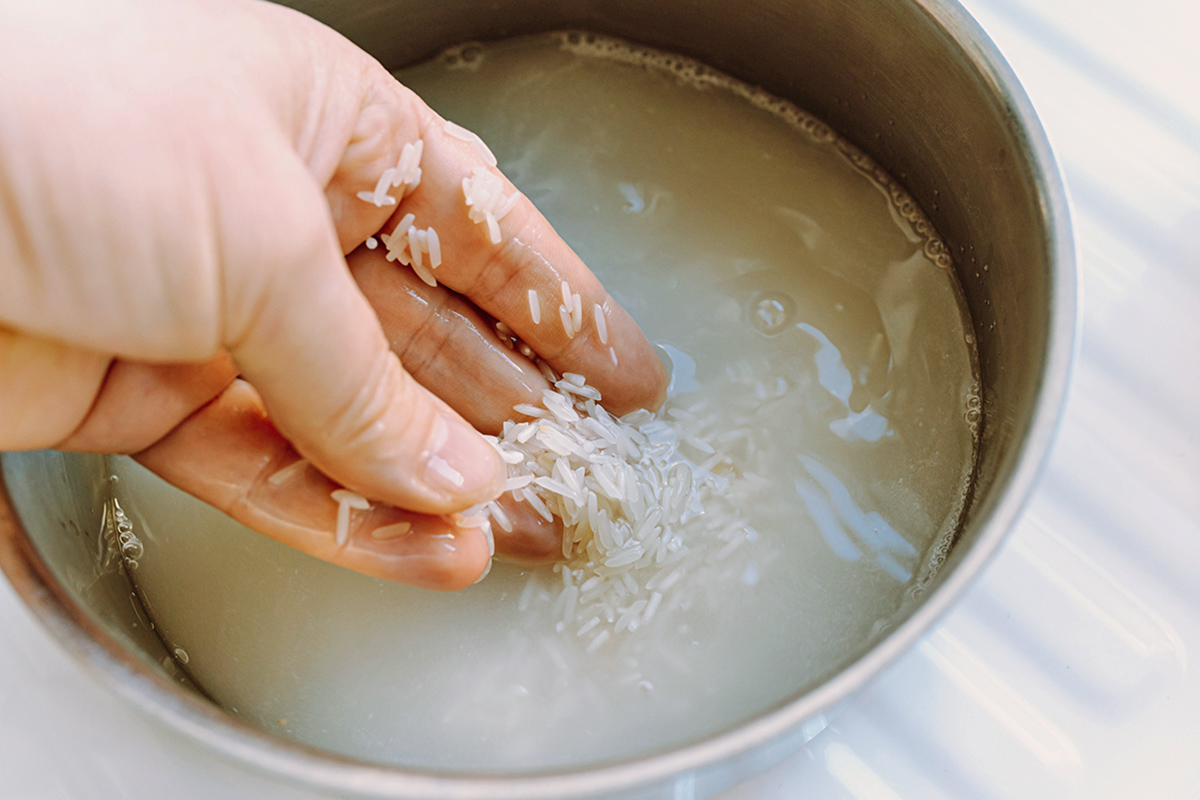
To fertilize plants with rice water, you’ll first need to make — or at least rinse — some rice. Start by measuring the rice and adding it to a mixing bowl. Fill the bowl with cold water until the rice is fully covered, and then use your hands to swish it around for about 10 seconds. Next, grab another bowl and a sieve, and strain the rice, letting the drained water collect in the new bowl underneath.

Advertisement
Related: Stop Your Plants From Leaning With This Free Fix

Once you’ve collected your rice water, pour it into a small watering can and add it to your plants’ soil. The amount to use depends on the plant, but a general rule of thumb is 1 cup (or less for smaller plants). As with other fertilizers, houseplants need rice water only one to two times per month during their growing season, so be careful not to overdo it. Providing them with too much rice water can result in overfertilization, which can lead to a range of problems, from root damage to nutrient imbalances.

Advertisement
Featured Image Credit:  Larisa Stefanuyk/ iStock | Updated  Sep 22, 2025 |
Jessie Quinn
Writer
Jessie Quinn is a Los Angeles-based lifestyle journalist with words published in PEOPLE, StyleCaster, Apartment Therapy, The Spruce, Byrdie, and more. She has a Bachelor's Degree in fashion journalism from Academy of Art University and her work spans across many categories, including style, beauty, home, health, crafts, and more.
This article is for general informational purposes only.
Featured Image Credit:  Larisa Stefanuyk/ iStock | Updated  Sep 22, 2025 |