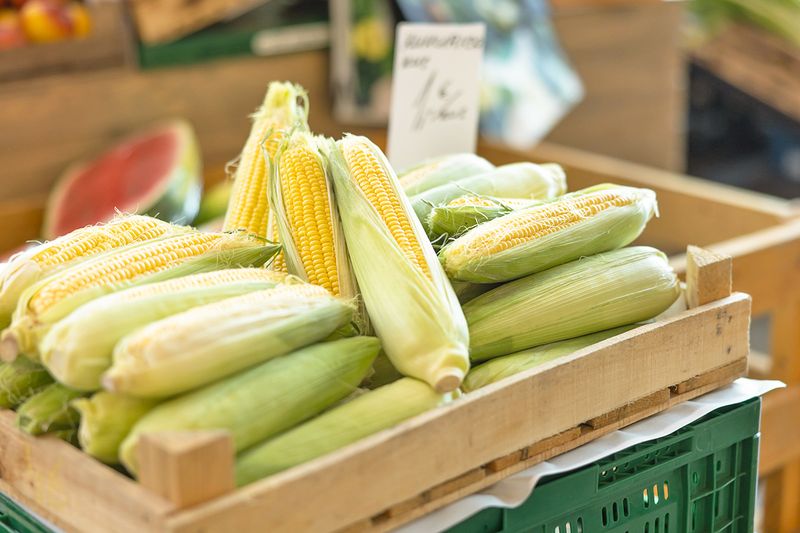
Farmers will tell you that if you want the very best corn, “bring the pot to a boil, then go out and pick a few ears.” Sadly, we don’t all have enough outdoor space to grow our own. But these three tips will help you choose the freshest corn at any supermarket, roadside stand, or farmers market.
1. Inspect the Corn Husks
The corn husks, the outer wrappers that hide and protect the ear, are the first thing you should inspect. You’ll know in an instant whether the corn you’re looking at is past its prime because the husks will have started to yellow and dry out — a clear sign of aging.
The kernels inside don’t lose moisture as quickly as the outer husks, which act as a natural barrier to slow evaporation. But here’s the catch: The sugars that give corn its sweetness begin converting into tasteless starch the moment it’s picked. In heirloom varieties of sweet corn, an ear that’s been off the stalk for 24 hours has already lost half its sugar — and its sweetness. Fortunately, modern hybrids have been developed to slow this conversion process and retain their flavor for several days, especially when refrigerated.
More from our network
House Outlook is part of Inbox Studio, which publishes content that uplifts, informs, and inspires.





2. Check Out the Silk
If the husks are still green, moist, supple, and tightly wrapped around the ear, the corn is likely fresh. But is it fully mature and ready to deliver the best possible flavor? To answer that question, examine the tassel and the strands of “silk” that make it up.
As an ear ripens, the exposed portion of the silk turns from yellow-green to yellow to brown. If you pull back the very tip of the husk, the silk inside should remain a pale yellow-green. If the ends are brown and the inside portions are pale, the corn is both mature and fresh.
3. Heft the Ear
One of the most useful rules for selecting produce is that it should feel heavy for its size. That applies to corn, too, because heavy ears are filled to the brim with plump, moist kernels. Pick up a few ears, and you’ll quickly find that some feel heavier and fuller than others. Those are the ones you want.
While holding an ear, run a finger along the husk to feel the rows of kernels underneath. Imperfectly pollinated ears will sometimes have sparse rows or gaps where kernels are missing. A quick finger-check will catch those, so you get full value for your dollar.