Pat Your Way to Perfection
Before you start cooking, remove the steak from its packaging, drain the excess juices, and place it on a clean cutting board lined with a few paper towels. Take a new paper towel and press it firmly into the surface of the meat, targeting the top and edges. Then, flip the steak over and repeat the process on the other side to soak up any moisture.
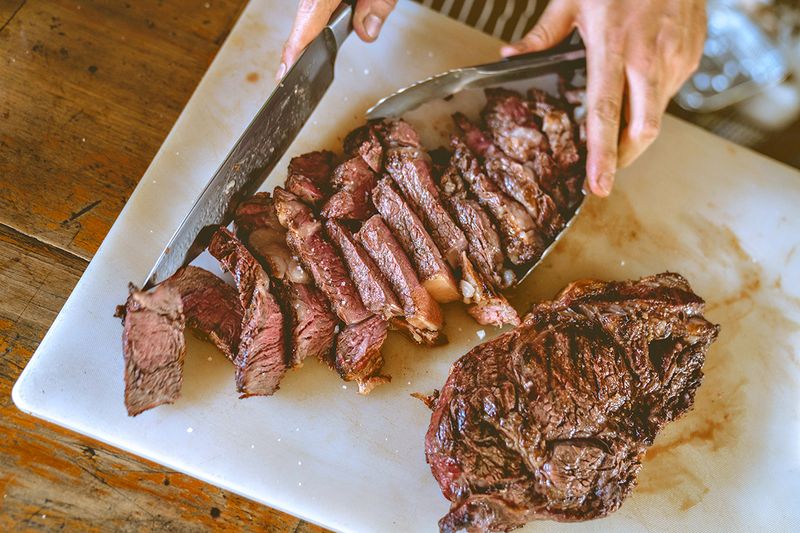
As deceptively simple as it sounds, this is a powerful technique. What sets restaurant steaks apart is largely the chef’s ability to get a perfect, evenly browned sear on the beef. Steak houses do that on high-powered gas grills, but fine-dining establishments are equally adept at crafting a beautiful steak in just a skillet. Drying the surface of the meat before cooking it isn’t the only thing that goes into a restaurant-quality steak, of course, but it’s a great starting point.
You also need high heat to brown the beef effectively, creating bold, rich new flavors through what’s called the Maillard reaction. During this process, the amino acid molecules in the meat’s protein and the glycogen molecules (these are made of natural sugars and act as fuel for muscle cells) get broken down by the heat and reassembled into hundreds of new aromatic molecules. That’s where browned meat gets much of its flavor, but — this is the key point — it happens at temperatures significantly higher than the boiling point of water. That’s why drying your beef is so important.
Searing, Not Steaming
If the surface of your steak is still damp from its packaging, wet from salt drawing out the juices, or dripping with marinade, it can’t sear when it hits the pan or grate. Searing has to wait until all of that surface moisture has been converted to steam and evaporated, and steamed meat is not very appealing.
More from our network
House Outlook is part of Inbox Studio, which publishes content that uplifts, informs, and inspires.



If you take five seconds to blot the steak dry with a paper towel before cooking, it will be ready to sear as soon as it hits the heat. This holds true whether you’re working with a gas grill, charcoal grill, cast-iron pan, or grill pan; no matter the cooking method, the Maillard reaction can’t begin until the surface is devoid of moisture. So keep that roll of paper towels handy, and let your friends wonder how you’ve suddenly leveled up your steak game.