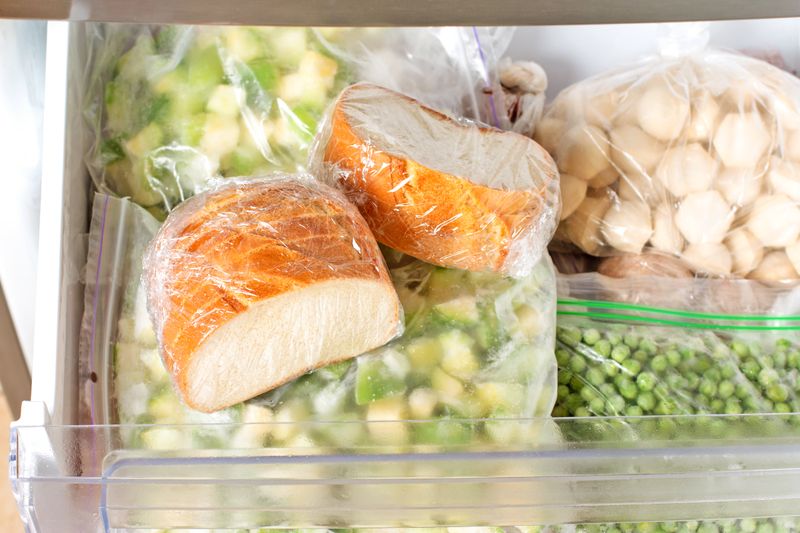
Why? Because quickly digested carbs can cause blood sugar spikes that are dangerous for diabetics and can leave the rest of us feeling sluggish. That’s unfortunate news for bread lovers — especially fans of white bread, which is the classic example of a high-glycemic index (GI) food. But there’s a silver lining: It turns out that freezing bread can actually lower its GI. Here’s the science behind how it works.
Why Freezing Bread Lowers Its GI
The starches in flour are complicated tangles of simple sugars, but our bodies are good at “untying” those knots and turning them back into glucose. This is why your blood sugar spikes after eating bread. So, how does freezing come into the picture? Well, when you bake bread, heating the dough turns those starches soft and gel-like. That’s why a loaf fresh from the oven feels a bit doughy even when it’s perfectly baked. As it cools, the bread loses its doughy texture but stays soft.
But when you freeze that bread, you force the starches to change their structure. They recrystallize into a firmer, more stable form through a process called “retrogradation.” In this new form, the starches resist your body’s attempts to break them down into sugars, which slows their absorption into your bloodstream. These are referred to as “resistant starches.”
More from our network
House Outlook is part of Inbox Studio, which publishes content that uplifts, informs, and inspires.





How Resistant Starches Change Your Bread
There is a slight catch: Retrogradation makes the bread lose some of its softness and it may feel a bit drier in your mouth. If you’re using it in sandwiches, for example, you’ll want to freshen it up just as you would with stale bread. Toasting it is even better. Not only does it mask the textural change, but a study out of England found that toasting frozen bread actually reduces its GI even further.
Most of us know that fiber is good for gut health. The cool thing about resistant starches is that once they reach your gut, they act much like the heart-healthy soluble fiber found in oats and beans. They’re classified as prebiotics, meaning they’re food for the probiotic microbes in your digestive system. So, while freezing won’t turn bread into a superfood, it does lessen the loaf’s glycemic impact.