You’ll find plenty of commercial produce washes on store shelves, but the USDA remains skeptical. The agency argues that these washes haven’t been well studied and raises concerns about the chemical residues they leave behind. Fortunately, a science-backed alternative exists that is inexpensive and relies on ingredients you likely already have on hand. Here’s how it works to keep your produce safe.
Cleaning Fresh Produce With Hydrogen Peroxide and Vinegar
Back in 1996, researcher Susan Sumner — then at the University of Nebraska and later Virginia Tech — discovered that two common household products could be a produce-cleaning powerhouse. By pairing distilled white vinegar with 3% hydrogen peroxide, she found they could kill nearly all salmonella, shigella, and E. coli bacteria, even on produce deliberately contaminated at high levels. Here’s the process:
• Fill a spray bottle with distilled white vinegar, or find a spray mechanism to fit the vinegar bottle. Do the same with 3% hydrogen peroxide; make sure the bottle is dark or opaque, as light breaks down the active ingredient.
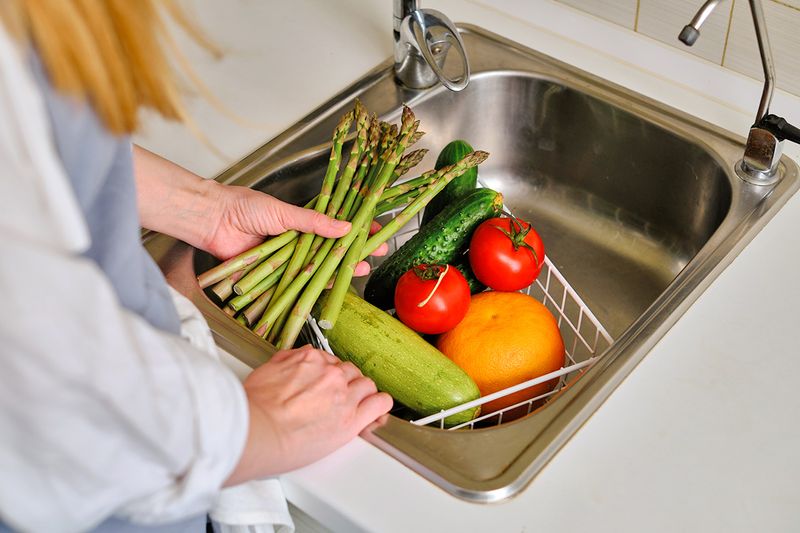
• Wash your produce first under clean, running water to remove any dirt that might give bacteria a hiding place.
• Spray the produce thoroughly with the vinegar, then immediately follow up with the hydrogen peroxide. Your produce should be visibly wet and glistening.
• Allow the produce to sit for at least 20 minutes.
• Rinse the produce under cool, running water for 30 to 60 seconds to remove any remaining vinegar or hydrogen peroxide. (Note: Trace amounts of hydrogen peroxide are generally considered safe to consume, as the compound eventually breaks down into water and oxygen when exposed to light and air.)
More from our network
House Outlook is part of Inbox Studio, which publishes content that uplifts, informs, and inspires.





The Do’s and Don’ts
A couple of final notes: First, to avoid cross-contamination, wash your hands thoroughly before you begin. Second, don’t combine the distilled white vinegar and hydrogen peroxide in the same bottle — mixing them ahead of time reduces their effectiveness.
For delicate produce such as greens and berries, wait until you’re ready to use them before washing. For sprouts, swish them in a bowl of hydrogen peroxide followed by a dip in vinegar (or vice versa). Finally, don’t use this hack on cantaloupes. Their rinds are too porous and rough for the treatment to work, and the fruit can absorb the taste. Scrub those under running water with a stiff brush instead.