There are some foods that people tend to approach with an extra degree of caution, and chicken — despite being so popular — is one of them. There’s a good reason for that: Most of the chicken in our food supply comes from large factory farms, where conditions are prime for the spread of common…
While you might choose to ignore official temperature recommendations if you prefer a medium-rare steak or a soft egg, most of us are happy to accept the guidance on chicken. The USDA specifies that chicken should reach an internal temperature of 165 degrees Fahrenheit, but you may not need to cook your poultry as long as you think to guarantee food safety. Here’s why.
Cooking Chicken to a Safe Temperature
Here’s the thing about the USDA’s official temperature recommendations: They’re conservative by design, focusing on a temperature that will kill bacteria instantly. However, according to the USDA’s own guidance for commercial food producers, a lower temperature held for a longer time works just as well. For example, maintaining a temperature of 150 degrees Fahrenheit for exactly 52 seconds gives the same result. The problem is that food manufacturers have the resources to be that precise, and home cooks like us don’t. The good news is that we don’t have to.
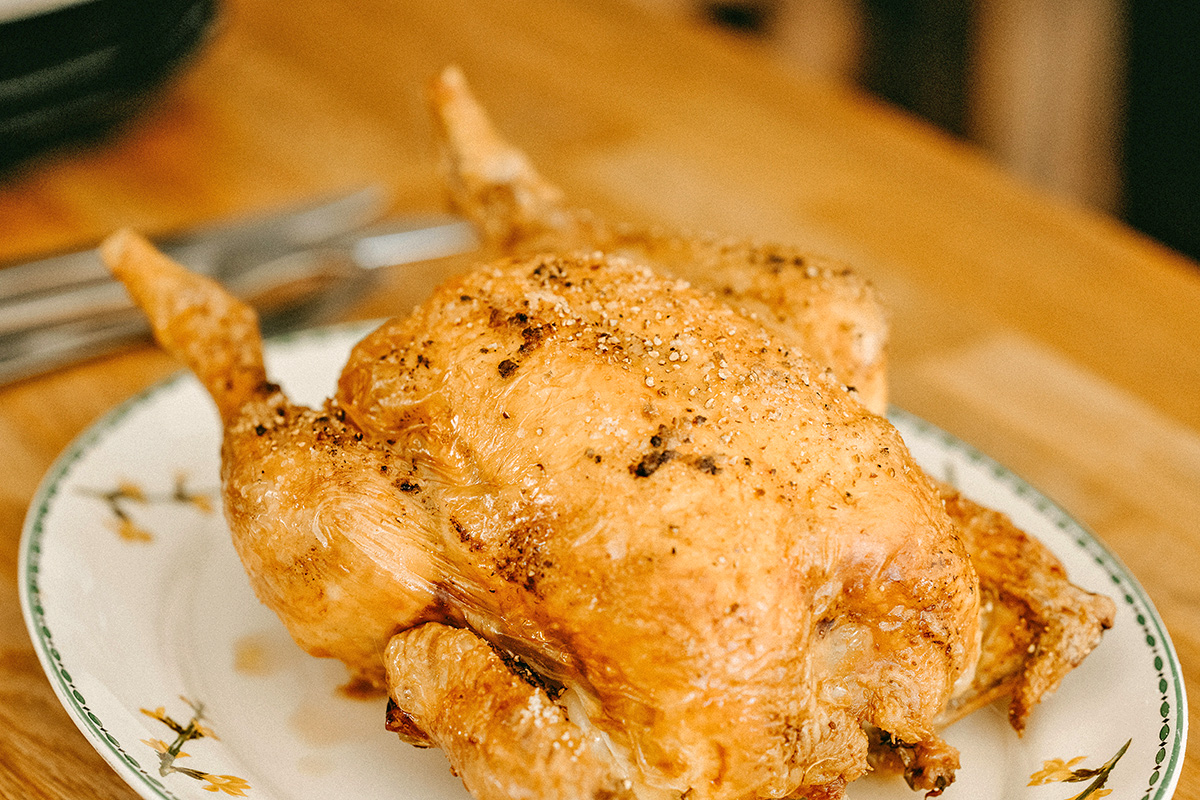
That’s thanks to something called “carryover cooking.” When you remove a whole chicken (or a piece of chicken) from your stove, oven, or grill, a lot of heat is already trapped inside. This heat means the cooking process will continue, and the interior temperature will continue to rise. The bigger the cut, the more carryover cooking you’ll see. A whole chicken retains more heat than a leg quarter, which retains more heat than a boneless breast.
More from our network
House Outlook is part of Inbox Studio, which publishes content that uplifts, informs, and inspires.




A Meat Thermometer Is Essential for Food Safety
So relax a little, and allow time for carryover cooking when preparing chicken. For a whole bird, you can safely pull it from the oven when the temperature hits 150 to 155 degrees Fahrenheit. For smaller cuts, 155 to 160 degrees Fahrenheit is a safe range. The only way to know for sure, however, is with an accurate meat thermometer. Check the temperature in a couple of places before you take the chicken off the heat, and then leave the thermometer in place while the meat rests for five to 10 minutes before serving. As long as the internal temperature stays at 155 degrees Fahrenheit or above (in the lowest-temperature part) for at least a minute or two, you’re golden.